NMB Meets Rocca Holly-Nambi
Uncommon Land, by Wildworks. Image by Paul Box
Rocca Holly-Nambi is the director of B-Side, an arts organisation based on the Isle of Portland in Dorset. In recent years, b-side has grown from a biennial festival into a year-round cultural offering: embedding artists into heritage sites, projecting onto lighthouses, parading through streets, and now running a bed and breakfast as a community asset and creative retreat.
I was blown away when I visited the festival last year on Portland, for the opening: the richness, variety and quality of the work - that is uniquely Portland and very, very special as a result.
Here we discuss all things b-side, what’s happening next and how ideas around care; people, place and the environment permeate through all that Rocca and b-side does.
The B-Side team: Left to Right, Sandy Kirkby, Poppy Hardwicke, Cat Wightman, Catherine Bennett, Maddison Collymore, Rocca Holly-Nambi
Tell me a bit about you, and b-side. How would you describe it to someone who's never been (to Portland)?
I am proudly not sure of who or what I am! But right now I'm the Director of b-side, an arts organisation based on - and very much obsessed with - the Isle of Portland.
Portland is a unique island off the South coast of England.
b-side is a festival — a cross art form festival that happens every September, across the whole island. Its focus is to bring artists and communities together to make artworks that tell the story of the people and place of Portland.
We don't have any purpose-built art venues, and we're okay with that. We show work in heritage sites, ex-military sites, we project things onto lighthouses and cliffs, we take audience members down cliffs while giving poetry lessons with artists, we pop up in fields. We work with the island and its assets — cultural, social, historical, contemporary.
The festival always ends in the Portland Parade, where artists, volunteers, audiences, residents, and visitors all dress up as weird and wonderful as we can and we parade ourselves through this beautiful street on Portland, as a collective celebration.
You've recently added a bed and breakfast to b-side. Which made total sense when I visited, and with hindsight but perhaps a little unusual — what's the thinking behind the bnb-side?
For two years we've been running the bnb-side — a bed and breakfast that sits just above our b-side project space in a village called Fortuneswell. Fortuneswell is beautiful, vibrant and unusual, but it's also the part of the island that's been most extracted from and done to, in terms of investment. There are plans to build an incinerator very close to where our project space and B&B are. There are also plans to mega-develop the area in ways that people hope might benefit communities. It's in a real state of flux — and that's exactly why b-side wants to stay there.
We run this beautiful B&B that overlooks the sea on one side and our struggling-but-surviving High Street on the other. It runs as a straightforward bed and breakfast that generates surplus for the festival, but increasingly — especially over winter — we've been running it as a place for creative retreats. People come to the island and experience a whole network of Portland artists delivering poetry workshops, ceramics, watercolour, outdoor painting — using the very clay and stone that makes up the island to produce their own work.
This feeds a hyperlocal economy. It gives year-round income to artists who live on the island, and to local businesses — saunas, bakeries — who contribute their produce and skills to host people. We're now looking to run residencies and respites too: low-cost or free stays for artists, cultural leaders, community members who might be at the verge of burnout or just need to come, think and rest. So the island, and b-side, and the bnb-side, become a place for hosting, for care, for welcome.
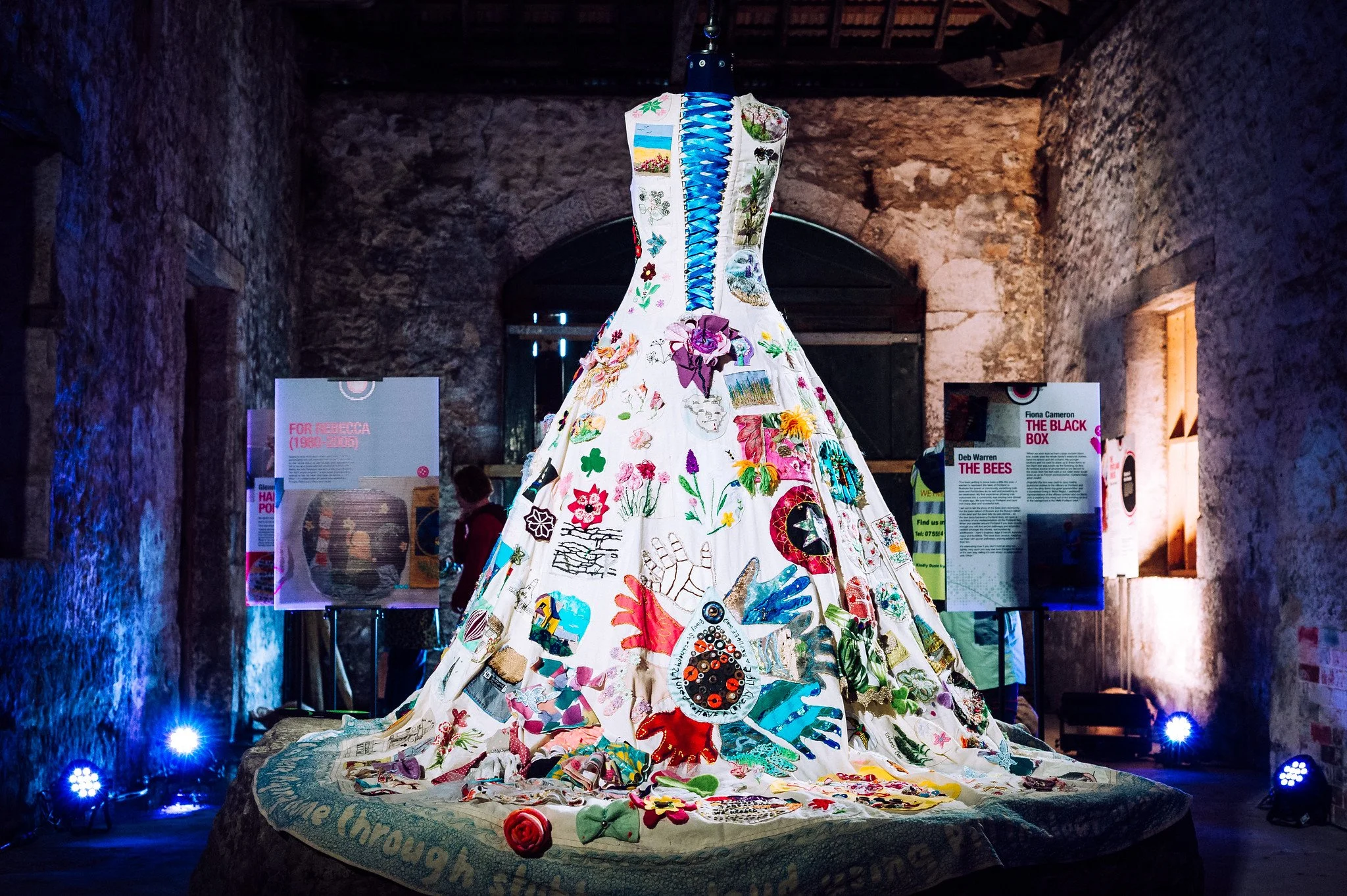
The Portland Dress, by Antje Rook, Sarah Elizabeth, and over 300 Portland residents. Image by Pete Millson.
B-Side has run for years under the curatorial theme of ‘Common Lands’. What drew you to that as an idea?
Common Lands has been our driving theme for six years now. It started with the literal meaning — the actual processes and history of commoning on the Isle of Portland. Who owned which bits of land? How did farming change that? How did inheritance structures change it? In Portland, for example, land was often inherited through the maternal line — through the female line — and we're slowly investigating why that was and what impact it has on the level of inclusivity and diversity on the island today.
But the ‘S’ in Common Lands — lands, plural — is really about asking: who gets the right to live on Portland? Who gets to call it home? What does it mean that we've had such a long history of migration to and from this island?
That question became very live when the Bibby Stockholm arrived in 2024 — the barge that held over 500 asylum seekers, moored just off Portland in the port. We developed 2024’s festival to think about what it meant to have these new visitors to the island, and how we could help build a bridge of community connection and care. The community on Portland made a really strong collective stance — they decided they wouldn't be part of exclusion. Residents formed a group called the Portland Global Friendship Group, which became this incredibly organised, sensitive network of support. People who'd lived on the same street for 30 years and never met each other suddenly became known to one another because they were both leading a walk for the guys on the Bibby. New friendships formed — hyperlocal ones, and new ones with the people who'd been forced to live on that vessel.
What I find fascinating is that the deeper we go into understanding our island — the history of a particular field, the story of a particular piece of rock — the more we find international commonalities. The way Portland's cliffs are being battered by climate change has deep parallels with communities elsewhere in the world that already lacked the systems to cope with flooding or drought, and are being doubly, triply affected. You go micro and you end up somewhere very universal.
Climate runs through a lot of what you're describing. How does it show up specifically in the work?
The island is a fascinating and deeply troubled site for it. It's been quarried from the inside — there are these massive bowls where stone has been extracted, and huge mines that travel through the island where stone is taken out from within. At the same time it's an island, so its cliffs are literally crumbling away. Footpaths that exist one day are in the sea the next. You can walk around the whole island in a day, so you feel the impact of the environment on the place in a very direct, physical way.
And through the friendships we build every day working on the island, you also come to understand who's most being most affected — compared to people who have cushions of privileges that comfort certain lives over others. In comparison to second (and third and forth) homeowners, for example, there's an urgency - a criticality of care - needed for some people just to be able to remain on the island.
For us it always comes through the lens of: what stories can be told when artists and communities come together in a place like Portland? How do we highlight the impact of the growing climate emergency onto our island? And when thousands of visitors come, what do they take home with them — back to wherever they've travelled from — that might start to impact their own locality?
b-side 2026 — this September — is the third chapter of Common Lands, titled 'That Other Place'. What's the question it's asking?
It asks, what happens if the land just isn't working? What happens when we're seeing signs that we don't know how to live on this land anymore? Maybe we need to look to other lands — digital lands, queer worlds, othered worlds, alternative practices — to find new ways to live on our island, and on land in general.
That Other Place is a looking-at-oddness, at islandness, at queerness, at weirdness — desperately trying to excavate new stories and new ideas of how we might live together.
We've just selected 15 artists/arts collectives who are running with these ideas - the diversity of their thinking around otherness is breathtaking. It’s going to be two years of bringing out these themes of ‘that other placeness’, with these incredible thinkers and makers, and we’re honoured that it’s happening.
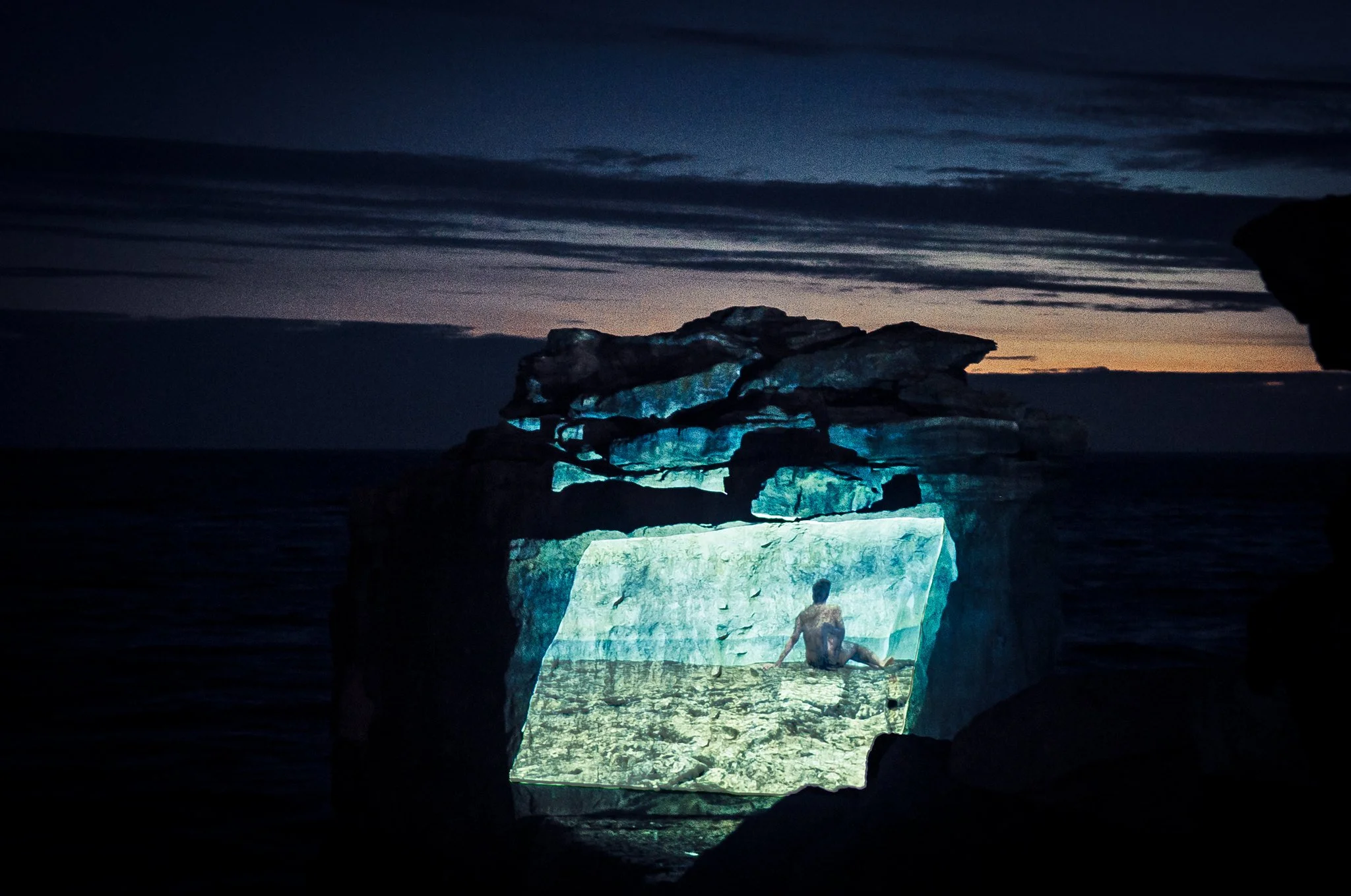
Requital. The Lighthouse as The Siren, by Babar Suleman, Image by Pete Millson.
How do you think about sustainability at b-side itself — as an organisation, as a community asset etc?
We think we need to be sustainable in three ways simultaneously. Social sustainability — caring deeply for the 50-plus volunteers who bring the festival to life each September, and for the generosity of our communities who say yes when artists with bonkers, brilliant ideas arrive on the island. Financial sustainability — not just for b-side but for the island itself. How do we support each other's businesses collectively to generate a stronger web of financial care and sharing? And then Environmental - how do we look after the island itself — the soil, the stone, the very thing we're standing on.
For us, sustainability is the meeting point of all three.
Right now our dream is to purchase the bnb-side building as a community asset. We're a Community Interest Company with an asset lock, so whatever we have — money or buildings — will always go back to the community. Any surplus is reinvested. Our dream is to own our building in Fortuneswell and run it as a cultural home — for our neighbours, for artists, for academics, environmentalists, anyone who feels they can come and give and take and give again to Portland.
As well as events throughout the year and at the bnb-side, the b-side Festival returns to the Isle of Portland from 10-13 September 2026. Find out more at www.b-side.org.uk. And go and see it for yourself.